

When I first started writing copy, I believed great marketing was primarily about clever headlines and elegant turns of phrase.
I obsessed over wordplay.
I admired advertisements that sounded brilliant.
I assumed that if a piece of writing was sufficiently witty or sophisticated, it would naturally persuade people to take action.
Over time, however, I noticed something curious.
Some of the most beautifully written campaigns failed to generate meaningful results.
Meanwhile, comparatively simple messages—often using plain language—consistently drove engagement, inquiries, and sales.
The difference wasn't vocabulary.
It wasn't creativity alone.
It was psychology.
The best copywriters understand that effective marketing isn't simply about crafting attractive sentences.
It's about understanding how people think, what motivates them, what holds them back, and what helps them feel confident enough to move forward.
In other words:
Great copy doesn't just sound good. It feels right.
It speaks to genuine concerns.
It acknowledges hidden objections.
It addresses emotional needs.
And ultimately, it guides readers toward decisions they already want to make.
At its core, copywriting is applied psychology: persuasion wrapped in empathy.
Whether you're writing landing pages, email campaigns, social media posts, or website copy, understanding the psychological principles behind human behavior can transform the effectiveness of your messaging.
Let's explore twelve of the most powerful persuasion principles that drive conversions, and how you can apply them ethically.
Why Buyer Psychology Matters More Than Clever Words

One of the most persistent myths in marketing is that consumers make purely rational decisions.
Behavioral science tells a different story.
People rarely purchase products or services based solely on logic.
Instead, emotions often initiate decisions, while logic helps justify them afterward.
Consider how people describe major purchases:
"It just felt like the right choice."
"I trusted them more."
"I could picture myself using it."
"I didn't want to miss out."
These statements reveal something important:
- Decision-making is profoundly human
- The most effective copy doesn't merely describe features
It addresses deeper psychological drivers:
- The desire for belonging
- The fear of making costly mistakes
- The aspiration for a better future
- The need for certainty and reassurance
- The pursuit of identity and self-expression
When copywriters understand these motivations, they stop asking:
"How can I sell this?"
Instead, they begin asking:
"How can I help readers make an informed decision that genuinely benefits them?"
That subtle shift changes everything.
Because persuasion, when practiced ethically, isn't manipulation.
- It's clarity
- It's empathy
- It's helping people recognize value they may have overlooked
And it starts with understanding the principles that shape human behavior.
1. Reciprocity: Give Value Before Asking for Commitment 🎁
Human beings are remarkably responsive to generosity.
When someone provides genuine value upfront, we often feel an instinctive desire to reciprocate.
This principle explains why:
Free guides generate leads.
Educational webinars attract prospects.
Valuable newsletters build loyal audiences.
Helpful consultations frequently convert into long-term partnerships.
The key, however, is authenticity.
People can quickly distinguish between genuine generosity and thinly disguised sales tactics.
Instead of asking:
"How quickly can I get something from this audience?"
Ask:
"How can I help them first?"
When you consistently provide useful insights, practical advice, or meaningful support, trust begins to accumulate.
And trust remains one of the most powerful conversion drivers available to marketers.
Copywriting Example: Reciprocity in Action
Instead of:
"Book a consultation today."
Try:
"Download our messaging checklist and discover three common mistakes that may be costing you conversions."
Value first.
Commitment second.
2. Social Proof: People Look to Others for Reassurance 👥

When uncertainty exists, people naturally observe the behavior and experiences of others.
This tendency makes social proof extraordinarily influential.
We see it everywhere:
- Customer testimonials
- Product reviews
- Case studies
- User-generated content
- Client logos
- Industry recognition
Social proof reduces perceived risk.
It reassures readers that others have faced similar challenges, and achieved positive outcomes.
However, authenticity matters enormously.
Fabricated testimonials or exaggerated claims often undermine credibility.
Instead, focus on real experiences and observable outcomes.
Even modest endorsements can be persuasive when presented honestly.
Copywriting Example: Social Proof in Action
Instead of:
"We're experts."
Try:
"Businesses across diverse industries trust our strategic content solutions to clarify messaging and strengthen audience engagement."
The difference lies in shifting attention from self-promotion toward demonstrated trust.
3. Authority: Expertise Builds Confidence 🎓
People are more likely to follow recommendations from credible sources.
Authority doesn't require arrogance.
It requires evidence.
Demonstrating expertise might involve:
Publishing thoughtful articles.
Sharing industry insights.
Highlighting certifications.
Showcasing relevant experience.
Speaking at professional events.
Referencing reputable research.
Authority signals competence.
And competence reduces hesitation.
Throughout my own professional journey, I've discovered that authority often emerges not from claiming to have all the answers, but from consistently asking better questions and sharing well-reasoned perspectives.
Readers aren't necessarily looking for perfection.
They're looking for guidance they can trust.
Copywriting Example: Authority in Action
Instead of:
"Our strategy works."
Try:
"Our approach integrates behavioral psychology, SEO principles, and audience research to develop messaging rooted in both creativity and evidence."
Specificity strengthens credibility.
4. Scarcity: Limited Opportunities Encourage Action ⏳

People naturally assign greater value to opportunities perceived as limited.
Scarcity creates urgency.
However, ethical considerations are critical.
False scarcity damages trust.
Genuine scarcity reflects real constraints:
- Limited enrollment periods
- Restricted inventory
- Fixed consultation slots
- Time-sensitive promotions
Used responsibly, scarcity helps readers prioritize decisions they may otherwise postpone indefinitely.
Copywriting Example: Ethical Scarcity
Instead of:
"Sign up anytime."
Try:
"Applications close Friday to ensure each participant receives personalized feedback."
The urgency is real.
And readers appreciate honesty.
5. Loss Aversion: Avoiding Loss Often Motivates More Than Seeking Gain ⚠️
Behavioral economists have repeatedly demonstrated that people tend to feel losses more intensely than equivalent gains.
In practical terms:
The pain of losing $100 often exceeds the pleasure of gaining $100.
Copywriters can ethically apply this principle by highlighting the consequences of inaction.
Consider questions such as:
What opportunities might readers miss?
What inefficiencies might continue?
What frustrations might persist?
The goal isn't fearmongering.
It's perspective.
Sometimes people need help recognizing the hidden costs of maintaining the status quo.
Copywriting Example: Loss Aversion
Instead of:
"Improve your website copy."
Try:
"Every day your messaging fails to connect with visitors represents missed opportunities to build trust and generate inquiries."
The focus shifts from abstract improvement toward tangible implications.
6. Curiosity: The Desire to Know More 🔍
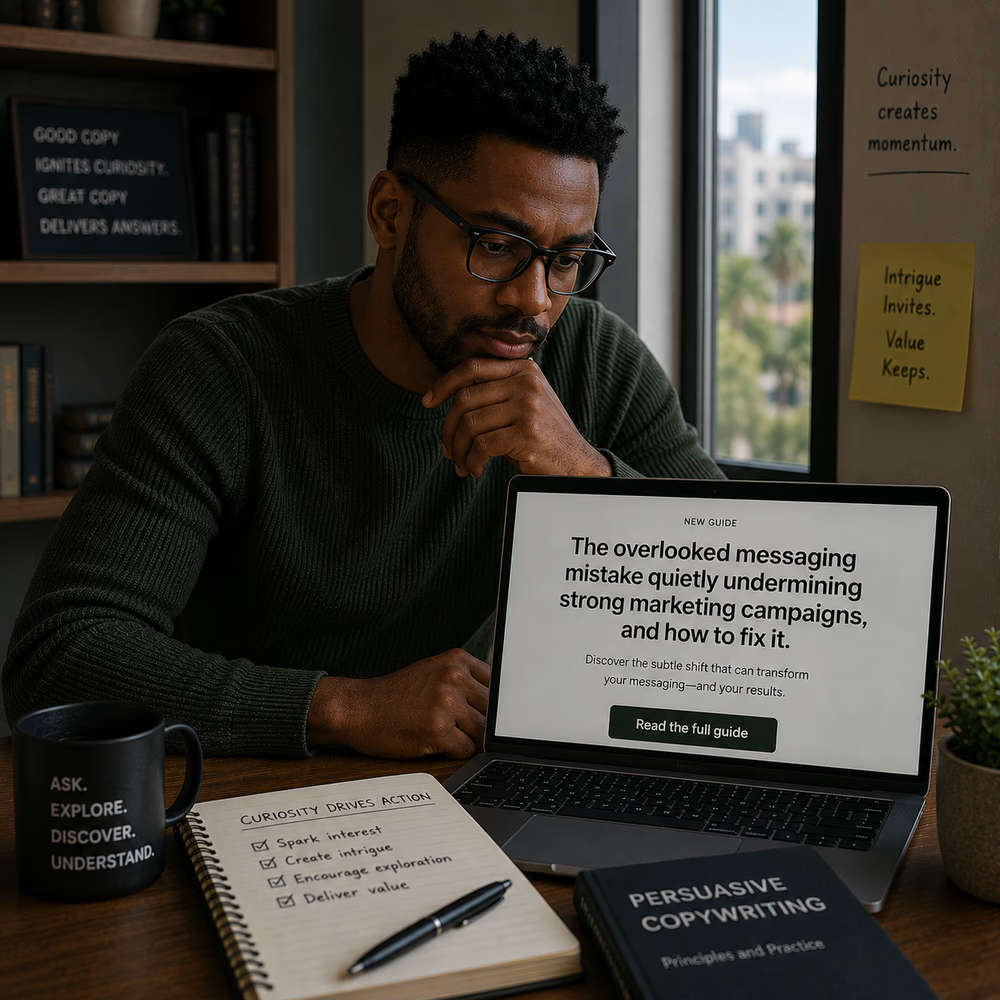
Curiosity creates momentum.
When information gaps emerge, people naturally seek resolution.
This explains the effectiveness of:
- Compelling headlines
- Intriguing email subject lines
- Open-ended questions
- Storytelling techniques
However, curiosity should lead somewhere meaningful.
Clickbait may attract attention temporarily.
It rarely builds lasting relationships.
Effective curiosity invites exploration while delivering substantive value.
Copywriting Example: Curiosity Gaps
Instead of:
"Our new guide is available."
Try:
"The overlooked messaging mistake quietly undermining otherwise strong marketing campaigns, and how to fix it."
The reader feels compelled to continue.
And when the content fulfills that promise, trust deepens.
7. Commitment and Consistency: Small Yeses Lead to Bigger Ones 🤝
People generally prefer to behave in ways that align with their previous commitments and self-image.
In marketing, this principle explains why seemingly small actions matter.
- Subscribing to a newsletter
- Downloading a checklist
- Attending a webinar
Each small step creates momentum.
When readers perceive subsequent actions as consistent with earlier decisions, they're more likely to continue the journey.
Copywriting example: Commitment & Consistency
Instead of asking immediately for a major commitment, invite smaller interactions first:
"Start with a free messaging audit checklist, and discover opportunities to strengthen your customer journey."
8. Cognitive Ease: Clarity Converts 🪶

The human brain prefers simplicity.
When information is difficult to process, uncertainty increases.
And uncertainty suppresses action.
One of the most common mistakes in copywriting is confusing complexity with sophistication.
Long sentences.
Excessive jargon.
Overly clever headlines.
They may impress peers, but they often frustrate readers.
Effective copy reduces cognitive load.
It feels intuitive.
Effortless.
Clear.
Ask yourself:
- Can readers understand this quickly?
- Does each sentence advance the message?
- Have I removed unnecessary friction?
In many cases, clarity outperforms cleverness.
9. Anchoring: The First Number Shapes Perception ⚓
People rarely evaluate information in isolation.
Instead, they compare it against an existing reference point.
This psychological phenomenon is known as anchoring.
Pricing pages use it frequently.
For example:
Presenting premium options first.
Highlighting original prices alongside discounts.
Comparing packages to establish relative value.
Anchoring isn't about manipulation.
It's about context.
It helps people make informed comparisons.
10. Specificity: Details Build Credibility 🎯

Vague statements invite skepticism.
Specific details inspire confidence.
Consider the difference between:
"Our strategies deliver results."
versus:
"After reviewing six months of Search Console data, I identified a recurring pattern: high visibility paired with low engagement across several content assets."
The second statement feels more trustworthy because it is grounded in observable reality.
Whenever possible:
- Use examples
- Reference timelines
- Provide measurable context
Specificity transforms claims into evidence.
11. Belonging: People Seek Identity and Community 🌍
Many purchasing decisions reflect identity as much as utility.
People ask themselves:
Is this for someone like me?
Do I belong here?
Will this help me become the person I aspire to be?
Strong copy acknowledges these deeper motivations.
It invites readers into communities, movements, and shared values.
This principle explains the effectiveness of phrases such as:
"Join thousands of business owners committed to ethical growth."
or
"For founders who believe trust is the foundation of sustainable marketing."
People don't merely buy products.
They invest in identities.
12. Future Self-Projection: Help Readers Imagine Transformation 🌱

One of the most powerful persuasion tools involves helping people visualize positive change.
What does life look like after the problem is solved?
- How will they feel?
- What becomes possible?
Transformation doesn't require exaggeration.
It requires clarity.
Show readers what success could look like.
Then provide a believable pathway toward it.
Copywriting example: Future Self-Projection
Instead of:
"Improve your content strategy."
Try:
"Imagine publishing content that not only attracts attention but consistently builds trust, strengthens authority, and generates meaningful inquiries."
People move toward futures they can envision.
## Ready to Put Psychology to Work in Your Marketing?
Understanding persuasion principles is one thing. Applying them strategically across your website, email campaigns, and customer journeys is another.
If you're looking to strengthen your messaging with ethical, conversion-focused copy rooted in audience psychology, I'd be delighted to help. Explore my services to discover how JBN Content Consultancy supports businesses in building trust, clarifying value, and creating content designed to move readers to action.
**→ Explore Copywriting & Content Strategy Services**
Turning Psychology Into Action: Three Timeless Frameworks
Understanding persuasion principles is valuable.
Knowing how to apply them consistently is transformational.
These frameworks provide practical structure.
AIDA: Attention → Interest → Desire → Action
One of marketing's oldest models remains one of its most useful.
- Attention: Capture interest.
- Interest: Demonstrate relevance.
- Desire: Highlight benefits and emotional outcomes.
- Action: Provide a clear next step.
AIDA works exceptionally well for:
- Landing pages
- Email campaigns
- Lead magnets
PAS: Problem → Agitate → Solution
This framework is particularly effective for addressing pain points.
Identify the problem.
Explore its consequences.
Present a credible solution.
PAS excels in:
- Headlines
- Sales pages
- Blog introductions
FAB: Features → Advantages → Benefits
Many marketers stop at features.
Effective copywriters translate features into outcomes.
- Feature: What it is.
- Advantage: Why it matters.
- Benefit: How it improves the customer's life.
Ultimately, people don't buy features.
They buy results.
Psychology in Practice: How I Approach Conversion-Focused Copywriting
Over the years, much of my professional work has been undertaken under non-disclosure agreements.
As a result, I cannot publicly disclose detailed client metrics or campaign outcomes.
However, one lesson has emerged consistently:
Effective copywriting begins with understanding human behavior.
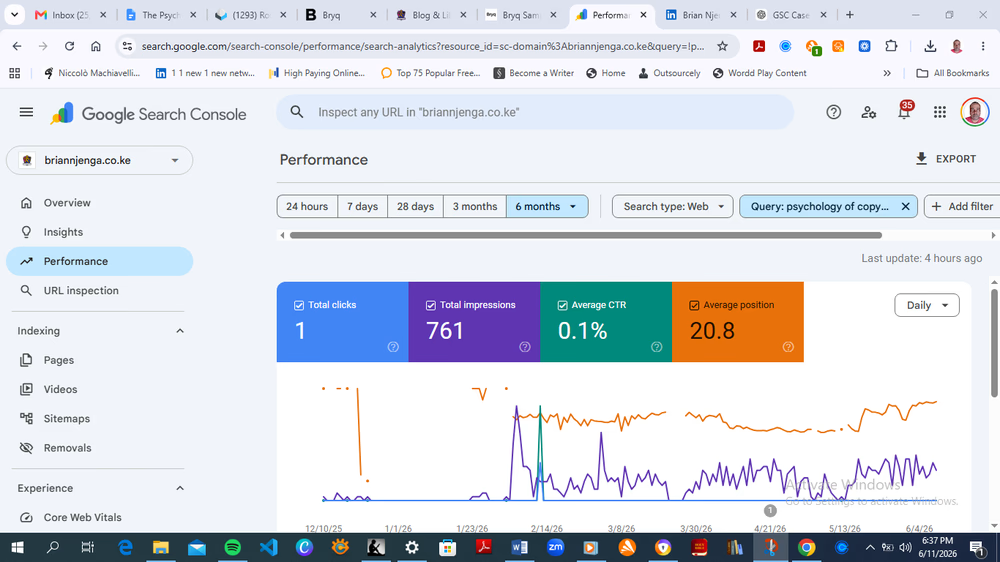
More recently, this principle became particularly evident while reviewing the performance data from my own website.
One article in particular—an earlier version of this very piece on the psychology of copywriting—generated approximately 8,836 impressions over six months.
At first glance, the visibility appeared encouraging.
Google clearly understood the topic.
Yet a closer examination revealed a challenge:
The article attracted only 18 clicks, resulting in a CTR of approximately 0.20%, despite occupying an average position of 11.51.
The insight was humbling.
Visibility alone does not guarantee engagement.
Readers must also perceive relevance.
This realization prompted several strategic questions:
- Were the headlines aligned with search intent?
- Did the metadata accurately communicate value?
- Were readers seeking practical guidance rather than conceptual overviews?
- Did the article sufficiently address commercial motivations?
Those questions have informed the very optimizations reflected in this updated guide.
Among the changes I'm implementing are:
- Strengthening title clarity
- Improving emotional resonance
- Expanding practical examples
- Enhancing internal linking
- Aligning calls-to-action with reader intent
- And restructuring the content to better support decision-making
The outcomes of these changes remain to be seen.
However, I intend to document and share those results transparently in a future follow-up article.
Because, ultimately, effective marketing isn't about appearing infallible.
It's about learning continuously, testing thoughtfully, and improving deliberately.
Psychology provides the lens.
Data provides the feedback.
Together, they create opportunities for meaningful growth.
The Ethics of Influence: Persuasion Without Manipulation ⚖️
Psychology can illuminate.
It can also exploit.
The difference lies in intention.
Ethical persuasion involves:
- Clarifying value
- Reducing uncertainty
- Respecting autonomy
- Helping people make informed decisions
Unethical persuasion relies on:
- False scarcity
- Fabricated testimonials
- Fearmongering
- Deceptive claims
Trust is difficult to build and remarkably easy to destroy.
The most sustainable marketing strategies recognize that long-term relationships matter more than short-term wins.
Persuasion should empower.
Never manipulate.
Final Reflection: Psychology Gives Copy Its Purpose ✍️🧠

The best copy doesn't manipulate.
It resonates.
It meets people where they are: acknowledging their aspirations, addressing their concerns, and helping them make confident decisions.
Throughout this guide, we've explored twelve persuasion principles that influence how people think and act:
- Reciprocity
- Social proof
- Authority
- Scarcity
- Loss aversion
- Curiosity
- Commitment and consistency
- Cognitive ease
- Anchoring
- Specificity
- Belonging
- Future self-projection
Individually, each principle offers valuable insights.
Together, they form a powerful framework for creating communication that is both persuasive and responsible.
At its heart, effective copywriting isn't about finding clever ways to sell.
It's about understanding people.
Their hopes.
Their hesitations.
Their desire to make choices that improve their circumstances.
As I've continued refining my own approach—through client work, thought leadership, and ongoing experimentation with the content published here on briannjenga.co.ke—one truth has become increasingly clear:
The most effective marketing doesn't pressure people into saying "yes."
It helps them understand why "yes" may already be the right decision.
Whether you're a founder seeking to strengthen your brand messaging, a marketer hoping to improve conversions, or a fellow writer exploring the psychology behind persuasive communication, I hope these principles encourage you to approach copywriting with both strategic rigor and genuine empathy.
Because trust remains the foundation upon which sustainable businesses are built.
And words, when used thoughtfully, have the power to create it.
Let's Build Copy That Connects and Converts 🚀
If your website is attracting visitors but struggling to generate meaningful inquiries...
If your messaging no longer reflects the value your business delivers...
Or if you're simply looking for a strategic partner to help transform complex ideas into clear, compelling communication...
I'd love to hear from you.
At JBN Content Consultancy, I help organizations develop content and messaging strategies grounded in audience understanding, behavioral insights, and ethical persuasion.
Services include:
- ✍️ Conversion-focused website copywriting
- 📧 Email marketing and nurture sequences
- 📈 Content strategy and messaging audits
- 🔍 SEO-informed content optimization
- 🧠 Thought leadership development
Because effective marketing isn't merely about generating clicks.
It's about building credibility, strengthening relationships, and creating experiences that inspire action.
→ Learn More About My Approach
0 Comments
Leave a comment