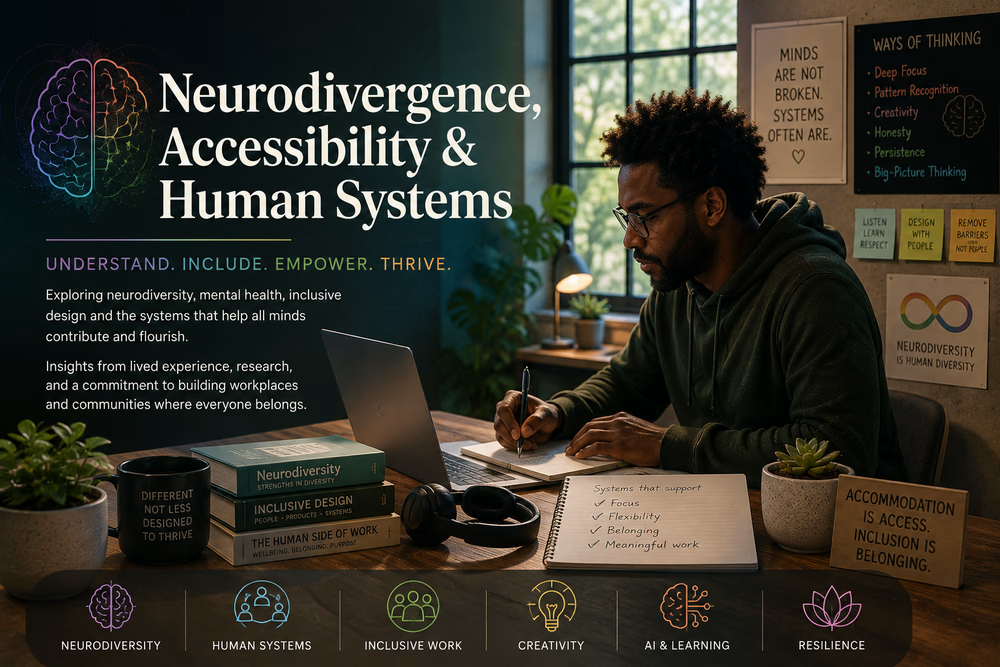
What happens when a mind shaped by schizophrenia rewrites the marketing rulebook?
💭 I shares how living with inner noise taught me to value clarity, honesty, and sensory calm in a chaotic digital world.
⚖️ From personal survival to professional insight, I outline how neurodiverse marketing champions transparency, accessibility, and empathy over manipulation.
🧩 Through lessons from Grammarly’s gentle persuasion and inclusive design principles, this piece urges creators to build content that soothes rather than shouts.
❤️ For marketers, designers, and brands ready to connect with every kind of brain — this is empathy as strategy. 🌈
Read

We’ve outgrown the grainy video calls and midnight pings. Remote Work 3.0 isn’t about more tools. It’s about mindset:
- 🧠 From hours to outcomes
- 🤝 From surveillance to trust economies
- 🧘🏿 From burnout to boundaries
- 🤖 From fearing AI to co-creating with it
My own journey through burnout and breakdown taught me this: remote work only empowers when it’s intentional.
Today, I design around async brilliance, mental health, and presence with my daughter.
👉 If work doesn’t need a building, what are we really building?
Read

AI critics often claim machines can’t be creative because they “just remix” existing ideas.
But here’s the twist: so do humans. From Shakespeare borrowing ancient plots to Beyoncé layering global sounds, creativity has always been recombination — with intention. 🔄✨
In this timely essay, I unpack what AI actually does, what it can’t (yet) replicate, and why emotional depth, lived experience, neurodivergent intuition, and purpose still belong exclusively to us.
🧠💬 Drawing on my own creative process and mental-health journey, I explore how AI can expand imagination rather than replace it — a co-pilot that challenges, accelerates, and inspires. 🚀
With cultural case studies, ethical concerns, and marketing stats, this piece asks a simple question:
If creativity is remixing, what matters most — the source, or the soul behind it? 🎭
Read

In places where mental health support is scarce, language becomes medicine.
💬🌍 This essay blends my lived experience with schizophrenia and my craft as a copywriter to explore therapeutic copywriting — writing that soothes, informs, and dignifies.
🩹 From trauma-informed microcopy (“You’re safe here”) to culturally rooted metaphors inspired by Ubuntu and Utu, I outline how brands can communicate care without cliché.
🧘♂️ This isn’t about marketing mental health — it’s about humanizing it.
For wellness startups, NGOs, and global health communicators, this is your guide to writing like someone’s tomorrow depends on it — because it just might. 💖
Read

After ten relentless months of work across multiple global clients, burnout pushed me past my limits — and into clarity.
💭 In this deeply personal essay, I reflect on my 2024 collapse, forced hospitalization, and the painful silence that followed from the very clients I once served tirelessly.
💔 Yet out of that breaking came rebirth — the founding of briannjenga.co.ke, the near-completion of Echoes of Valor, and a radical philosophy I now live by: Rest as Resistance.
🌙 Midweek pauses, creative stillness, and honest boundaries became my rebellion against the gig economy’s “always-on” myth. For freelancers, neurodivergent creators, and anyone balancing passion with survival — this is your permission to breathe. 🌿🧘♂️
Read