

The rise of generative AI has sparked a fierce debate across creative circles: Is artificial intelligence replacing original thought or simply remixing what we’ve already made?
As a working writer and strategist who has used AI tools to brainstorm, structure, and refine copy, I’ve thought about this question thoroughly.
And here’s the truth: the idea that AI isn’t “creative” because it remixes existing data?
That same critique could be applied to human creators, too.
So let’s unpack the myths.
And the potential.
The Remix Accusation: Where It Comes From 🔄
Critics argue that AI doesn’t create.
It just recombines what already exists. It’s a cut-and-paste machine that lacks imagination.
But here’s the twist: so are we.
Kirby Ferguson’s legendary video series “Everything is a Remix” reminds us that innovation is often recombination.
From Beethoven to Beyoncé, creators build on what came before.
Even Shakespeare borrowed stories from Roman, French, and Italian texts.
T.S. Elliot once said, "“Immature poets imitate. Mature poets steal.”
So is AI guilty of remixing?
Sure.
But that’s the starting point of creativity, not the end.
Human Creativity: Algorithmic or Inspired? 🧠🧩

The human brain is itself an algorithmic marvel.
We draw from experience, memory, and cultural context to generate ideas.
As someone who lives with schizophrenia, I’ve witnessed firsthand how the mind can leap between unrelated ideas.
Sometimes that’s a burden.
But often, it’s a creative superpower.
Our creativity isn’t “pure.”
It’s subconscious remixing, intuition, and learned patterns playing together.
Which is exactly what large language models simulate.
What AI Can’t Do (Yet): The Missing Ingredient 🧬
While AI can replicate tone and mimic structure, there are three human traits it lacks:
- Emotional depth: AI can simulate empathy, but hasn’t felt anything.
- Subtext & contradiction: Humans embrace nuance. AI flattens it.
- Vision: AI doesn’t know why it creates. We do. That sense of intention can’t be mimicked.
AI can finish your sentence.
But it doesn’t know if it should.
What AI Does Well: Expand, Amplify, Inspire 🚀
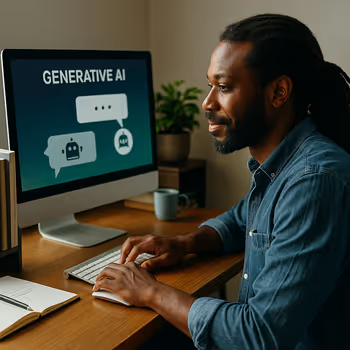
AI is powerful when used as a creative co-pilot:
- It generates headlines, structures articles, and rewrites content for different tones.
- It helps me explore angles I hadn’t considered.
- It never sleeps.
In my own workflow, AI tools like ChatGPT have helped me cut brainstorming time in half.
But the soul of the piece?
That’s still all me.
Redefining Creativity in the Machine Age 🔧🎭
It’s time to update our definition of creativity.
What if it’s not about being first, but being authentic?
Not about avoiding influence, but curating it intentionally?
Co-creation is the future: Humans + Machines.
Authors use AI to outline novels.
Designers use Midjourney to sketch concepts.
Podcasters use AI to transcribe and summarize insights.
Creativity isn’t dying.
It’s evolving.
Ethical and Cultural Concerns ⚠️🧑⚖️
Still, this renaissance comes with responsibility:
- Plagiarism: AI learns from artists who may never be credited.
- Bias: Generative tools can perpetuate stereotypes.
- Job displacement: We must ensure humans stay in the loop.
Originality matters, but so does authorship, credit, and context.
The Myth We Need to Let Go Of 🧨

AI doesn’t “fake” creativity.
It challenges us to rethink what creativity really is.
I no longer fear AI will replace me.
I fear creators who don’t evolve with it.
Creativity has always been remixing.
The question is, do you remix with purpose?
Because machines can’t give work meaning.
We can.
“AI doesn’t replace my mind. It mirrors it. But it’s still up to me to make meaning.”
🔍 Eye-Opening Stats & Real-World Use Cases
📊 AI in Creative Work by the Numbers
- Almost three out of four marketers use some kind of AI tool in their business
- AI is used by 44% of content marketers to compose drafts, 34% to write email copy, and 32% to repurpose material.
- AI is used by more than half of marketing teams to optimize content.
🎵 Creative Case Studies
- Paul McCartney used AI to isolate and enhance John Lennon’s vocals to complete a “final Beatles track” (“Now and Then,” 2023)
- Netfix uses AI to predict story arcs based on audience preferences for script development
- The New York Times employs machine learning to personalize headlines for readers without sacrificing editorial integrity
Would you know a remix if it moved you?
Maybe that’s the wrong question.
Maybe what we need to ask is:
🌀 Are we open to new tools that help us make timeless art?
0 Comments
Leave a comment