

For nearly two decades, carbon credits have dominated the sustainability landscape—measured in tons of CO₂ avoided, sequestered, or offset.
But as the planet warms and ecosystems fray, it’s become increasingly clear: carbon alone is not enough.
A forest is not just a carbon sink.
It is a living system of pollinators, seed dispersers, fungi, predators, and prey.
Wetlands do not simply trap emissions—they filter water, prevent floods, and host entire microcosms of biodiversity.
Enter the new frontier: biodiversity credits 🦋🌱.
Unlike carbon, which can be reduced to a metric ton, biodiversity is messier, richer, and harder to measure, but potentially far more transformative.
These credits represent restored habitats, thriving species corridors, and functioning ecosystems, offering companies and governments a way to not just neutralize their harm but regenerate the living fabric of Earth.
🌿 What Are Biodiversity Credits?

At their core, biodiversity credits are financial instruments that represent measurable gains in ecosystem health or species recovery.
A company, factory, or developer purchases credits to balance out the ecological damage of its operations.
But unlike carbon, biodiversity cannot be easily boiled down to a single metric.
This raises three key complexities:
- Multiplicity of Value: Are we counting species richness, genetic diversity, or ecosystem services like pollination?
- Locality Matters: A mangrove in Indonesia is not interchangeable with a prairie in North America.
- Time Horizons: Some species recover in years, others take decades.
Because of these complexities, biodiversity credits demand a more holistic framework than carbon markets.
🔎 Case Studies in Biodiversity Credit Pilots
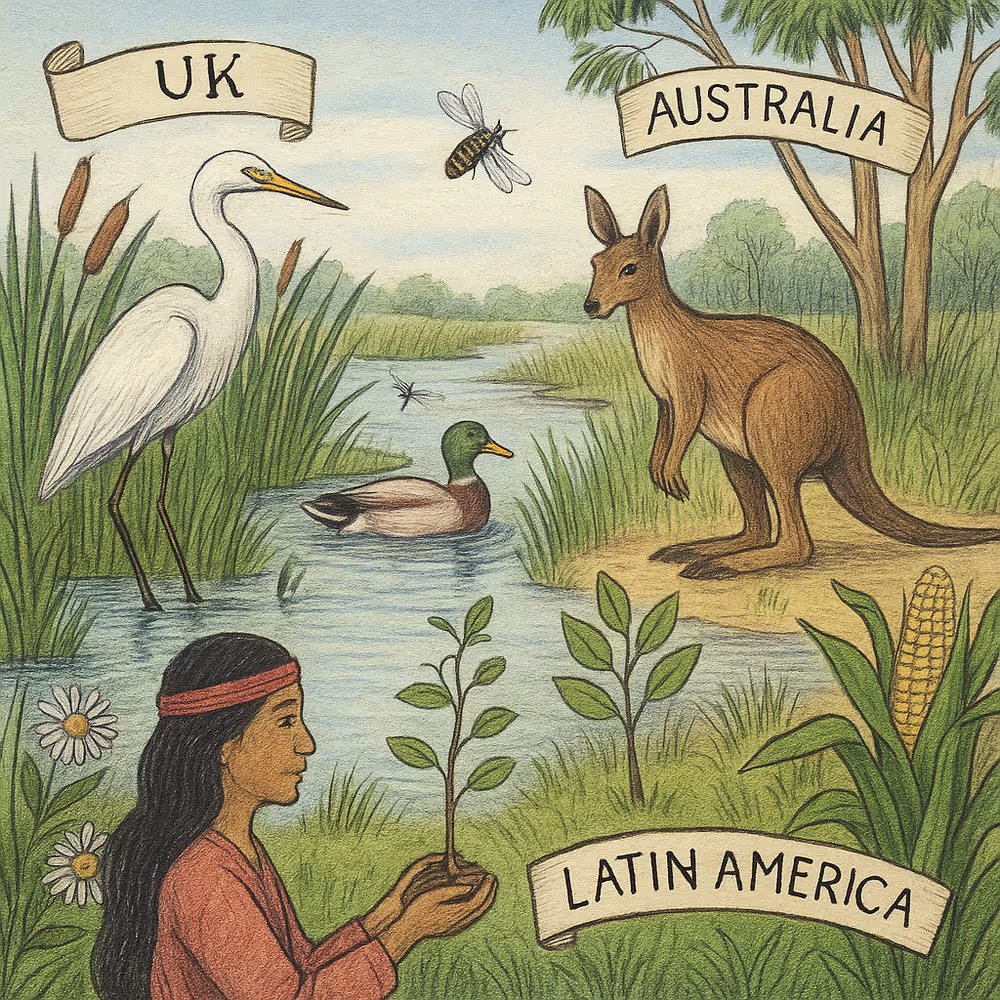
UK – Biodiversity Net Gain
Under the UK’s Environment Act, developers must deliver a 10% biodiversity net gain on projects.
Credits can be purchased to fund habitat creation elsewhere, ensuring no net loss of nature.
Australia – Biodiversity Offset Schemes
Pioneering work is underway to standardize credits for species restoration, with projects restoring koala habitats and native bushland.
Latin America – Indigenous-Led Biodiversity Markets
In Colombia and Peru, Indigenous communities are piloting biodiversity credit systems that reward forest guardianship, blending traditional stewardship with modern finance.
🌱 From Compliance to Competitive Advantage
Critics argue biodiversity credits are just “carbon offsets 2.0.”
Yet there’s evidence that forward-looking companies see them as more than compliance tools.
- Brand Differentiation: Imagine a product labeled “nature positive” 🍃, backed not just by carbon neutrality but by thriving bee populations or rewilded wetlands.
- Risk Mitigation: Healthy ecosystems buffer against floods, fires, and droughts—risks that directly affect supply chains.
- Investor Confidence: Frameworks like the Taskforce on Nature-related Financial Disclosures (TNFD) are making biodiversity risk part of financial reporting.
In short: biodiversity credits may soon determine competitive survival in markets as much as carbon credentials do today.
🧩 The SDG Connection
Biodiversity credits map directly to multiple UN Sustainable Development Goals (SDGs):
- SDG #15 (Life on Land): Restoring habitats, reversing deforestation, protecting species.
- SDG #14 (Life Below Water): Valuing coral reefs, mangroves, and wetlands.
- SDG #17 (Partnerships): Building bridges between governments, corporations, and Indigenous custodians.
But they also indirectly support:
- SDG #13 (Climate Action): Ecosystems like forests and peatlands double as carbon sinks.
- SDG #2 (Zero Hunger): Pollinator credits directly sustain food systems.
🌏 Alternative Worldviews: Beyond Markets, Toward Meaning

To avoid replicating the failures of carbon markets, biodiversity credits must be rooted in alternative worldviews:
Buen Vivir (Andean philosophy): Nature is not a resource, but a partner. Credits should reflect reciprocity, not extraction.
Ubuntu (African philosophy): “I am because we are”—biodiversity regeneration as a collective act, not an individual commodity.
Collective Mindfulness (Eastern-inspired): Valuing the unseen, the small, and the interconnected web of life.
These lenses remind us that while credits can mobilize finance, true regeneration requires cultural reorientation.
🐝 Challenges on the Horizon
The road to scaling biodiversity credits is littered with challenges:
- Metrics Dilemma: How do we avoid reducing “life” into simplistic data points?
- Equity Concerns: Will Indigenous and local communities benefit—or be sidelined?
- Greenwashing Risks: Will credits excuse continued destruction elsewhere?
- Market Volatility: Without robust standards, speculative bubbles may emerge.
Yet, each challenge also represents an opportunity to design better, fairer markets than carbon credits ever achieved.
🌳 Towards a Regenerative Future

Factories ringed with rewilded forests.
Highways intersected with green corridors.
Supply chains rated not just on emissions, but on pollinator health.
This is the vision biodiversity credits could unlock.
But only if we design them as tools of justice, not loopholes of convenience.
The rise of biodiversity credits is not just an economic innovation.
It’s a chance to rethink the social contract between industry and nature, moving from “do less harm” to “give back more than we take.” 🌿✨
🧭 Conclusion: A Call to Bold Imagination

Carbon was a start, but it was also a reduction. Biodiversity credits demand imagination, humility, and courage.
If we get this right, we can build markets that restore instead of extract, regenerate instead of degrade, and reconnect instead of divide.
As the series unfolds, we’ll explore:
- 🌲 Factories with forests.
- 🐾 Rewilding as industrial asset.
- 🦌 Species corridors as infrastructure.
- ⚖️ The ethics of financializing nature.
The question before us is not just technical.
it is civilizational:
👉🏽 Will biodiversity credits become another speculative asset, or will they herald a new age of regeneration?
The choice is ours, and the stakes couldn’t be higher. 🌍💚
0 Comments
Leave a comment