

Modern work culture has a complicated relationship with suffering.
Although few organizations explicitly encourage exhaustion, many continue rewarding behaviors that quietly produce it.
Workers are praised for:
- Working late
- Remaining constantly available
- Responding immediately
- Pushing through fatigue
- And maintaining performance regardless of circumstances
Endurance has become a professional virtue.
The ability to absorb pressure without visibly struggling is often interpreted as strength.
The ability to continue producing under increasingly demanding conditions is frequently treated as evidence of commitment.
Yet beneath this admiration lies an uncomfortable question:
What happens when endurance reaches its limits?
Every system eventually encounters constraints.
Machines break down.
Ecosystems become depleted.
Institutions experience fatigue.
Human beings are no different.
And yet many workplaces continue operating as though energy were infinite and recovery optional.
The future of humane work may depend on abandoning this assumption.
Not because performance is unimportant.
But because sustainable performance requires something endurance alone can never provide: renewal.
The Endurance Model of Work 🏃

Many modern workplaces still operate according to assumptions inherited from earlier industrial models.
The expectation is simple:
- Show up
- Remain productive
- Repeat
While knowledge work has transformed dramatically, many cultural expectations have not.
Workers are still often expected to be:
- Consistently available
- Perpetually responsive
- Continuously productive
- And indefinitely resilient
The tools evolved.
The expectations frequently remained the same.
This creates a subtle contradiction.
Knowledge work depends heavily on:
- Creativity
- Judgment
- Problem-solving
- Communication
- And emotional intelligence
Yet organizations often manage knowledge workers as though output were generated through predictable mechanical effort.
The result is a culture where endurance becomes the default strategy for addressing every challenge.
More work?
Push harder.
More complexity?
Work longer.
More uncertainty?
Stay available.
The problem is not effort itself.
The problem is assuming effort can expand indefinitely without consequence.
Why Energy Is Not the Same as Time
Workplace conversations frequently focus on time.
Calendars.
Schedules.
Deadlines.
Hours worked.
But time and energy are not interchangeable.
Two people may possess the same number of hours in a day while experiencing vastly different capacities to use them.
Likewise, the same individual may have dramatically different levels of cognitive, emotional, and physical energy depending on circumstances.
Energy is dynamic.
It fluctuates.
It requires replenishment.
And unlike time, it can be depleted.
This distinction is particularly important for knowledge workers.
Creative insight cannot always be scheduled.
Strategic thinking cannot always be forced.
Emotional resilience cannot always be summoned on demand.
Organizations frequently organize work around calendars while ignoring energy realities.
The result is predictable:
People begin managing exhaustion rather than performance.
The Hidden Cost of Sustained Performance 🧠

Not all work is visible.
Many workers carry significant forms of labor that rarely appear on performance reports.
As explored in The Hidden Emotional Labor of Being Professional, professional life often requires continuous emotional regulation.
People manage:
- Impressions
- Expectations
- Social dynamics
- Uncertainty
- And stress
For neurodivergent individuals, the burden can become even greater.
Many expend energy navigating:
- Sensory demands
- Communication differences
- Executive functioning challenges
- Social interpretation
- And workplace norms that were not designed with cognitive diversity in mind
This effort frequently remains invisible.
The work gets completed.
Deadlines get met.
Meetings are attended.
Externally, everything appears functional.
Internally, however, substantial energy may already have been consumed before the day's primary tasks even begin.
This is one reason burnout can seem so sudden.
What appears to outsiders as an abrupt collapse is often the culmination of months—or years—of unrecognized expenditure.
Burnout rarely arrives without warning.
It simply becomes visible later than the depletion that caused it.
Burnout Is Often a Design Failure ⚠️

Burnout is commonly framed as an individual problem.
People are encouraged to:
- Build resilience
- Manage stress
- Improve self-care
And strengthen coping strategies.
While these responses have value, they often overlook a more important reality.
Many burnout conditions are structurally produced.
Workplace design matters.
Communication norms matter.
Meeting cultures matter.
Leadership expectations matter.
As explored in Cognitive Load Is a Leadership Choice, organizations frequently generate cognitive burdens without consciously recognizing them.
Every interruption consumes attention.
Every unnecessary meeting fragments focus.
Every expectation of constant availability increases mental load.
Over time, these demands accumulate.
Burnout often reveals a mismatch between human capacities and organizational expectations.
The question is not why people burn out.
The more interesting question is why systems continue generating conditions where burnout becomes predictable.
Designing for Energy Rather Than Endurance 🌱
If endurance is not the goal, what should replace it?
The answer is not reduced ambition.
It is sustainable ambition.
Organizations designed around energy operate according to different principles.
Recovery Is Productive 🌙
Rest is often treated as the absence of work.
In reality, recovery is one of the conditions that makes meaningful work possible.
Focus Requires Protection ⏳
Attention is a finite resource.
Protecting concentration is not a luxury.
It is a strategic necessity.
Rhythm Matters 🎵
Human beings function through cycles.
Periods of effort must be balanced by periods of renewal.
Flexibility Creates Sustainability 🌍
Different people replenish energy differently.
Healthy systems recognize variation rather than enforcing uniformity.
Capacity Fluctuates 📈📉
Organizations frequently plan as though capacity remains constant.
Human beings do not operate this way.
Designing for reality produces healthier outcomes than designing around idealized assumptions.
Energy-aware systems do not eliminate responsibility.
They simply acknowledge biology.
AI, Automation & the Ethics of Energy

Technology can either amplify depletion or support renewal.
This distinction matters enormously as artificial intelligence becomes increasingly integrated into daily work.
In Designing AI for Repair, Not Just Efficiency, I argued that technology should help reduce unnecessary strain rather than intensify extraction.
Used thoughtfully, AI can:
- Summarize information
- Automate repetitive tasks
- Reduce administrative burdens
- Assist planning
- And preserve cognitive resources for higher-value work
Yet the opposite outcome is equally possible.
Organizations may use automation to increase expectations rather than reduce burdens.
Tasks become faster.
Deadlines become shorter.
Recovery windows disappear.
The problem is not technology.
The problem is the assumptions guiding its deployment.
Technology becomes humane when it protects human energy.
It becomes extractive when it merely increases demands.
Designing Cultures of Renewal
Workplace culture influences energy as profoundly as workload itself.
Some cultures normalize:
- Recovery
- Boundaries
- Thoughtful pacing
- And sustainable performance
Others celebrate:
- Urgency
- Perpetual availability
- Constant acceleration
- And visible busyness
This distinction connects directly to themes explored in The Cost of Speed and Slow Intelligence in Fast Institutions.
Acceleration often appears productive because it increases visible activity.
Yet organizations frequently discover that relentless speed erodes:
- Trust
- Judgment
- Creativity
- And resilience
Renewal functions differently.
It operates quietly.
It rarely generates immediate metrics.
But over time it produces something far more valuable: durability.
The healthiest cultures understand a simple truth:
Sustainable excellence depends not upon permanent intensity.
It depends upon repeated renewal.
Final Reflection: The Future of Work Beyond Survival 🌌⚡
Many workplace conversations focus on helping people survive.
Survive deadlines.
Survive pressure.
Survive uncertainty.
Survive change.
These goals matter.
But they are not enough.
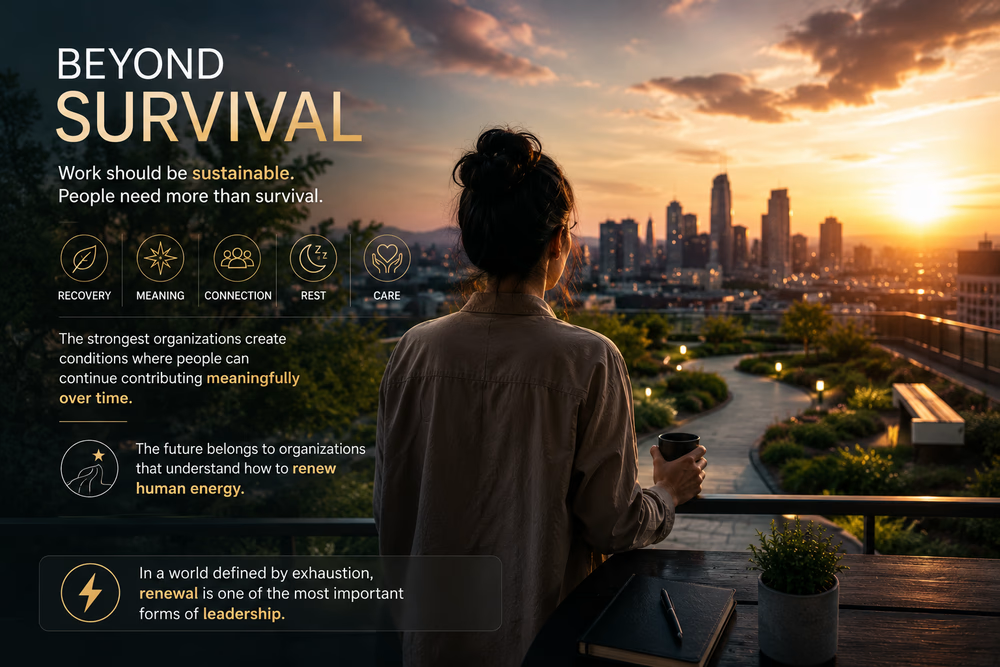
Work should be more than survivable.
It should be sustainable.
Human beings are not batteries designed for efficient depletion.
We are living systems.
Our ability to contribute depends upon:
- Recovery
- Meaning
- Connection
- Rest
- And care
The strongest organizations are not those that demand endless endurance.
They are those that create conditions where people can continue contributing meaningfully over time.
Because the future of work may not belong to organizations that extract the most energy.
It may belong to those that understand how to renew it.
And in a world increasingly defined by exhaustion, that understanding may become one of the most important forms of leadership available.
0 Comments
Leave a comment