
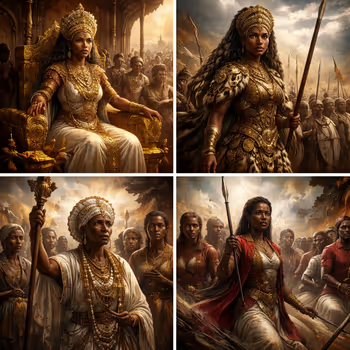
Across sub-Saharan Africa, women did not merely participate in resistance movements; they often authorized, legitimized, and directed them.
The colonial archive, filtered through European patriarchal assumptions, frequently treated African female authority as anomaly, curiosity, or emotional eruption.
Yet the deeper record — oral, constitutional, ritual, and dynastic — reveals something far more structural.
In many African societies, sovereignty flowed through maternal lines, queen-mother offices, spiritual custodianship, or institutionalized female military corps.
When empire pressed against these societies, women did not “step forward unexpectedly.”
They rose because their roles already required them to guard continuity.
Resistance, in these cases, was not improvisation. It was obligation. ⚖️
Constitutional Power: Queen Mothers in African Governance 👑
Yaa Asantewaa and the Golden Stool
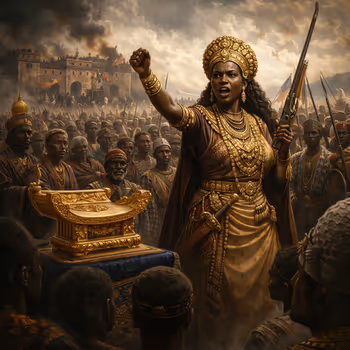
In 1900, when British Governor Frederick Hodgson demanded the sacred Golden Stool, he did not merely insult a throne.
He threatened the metaphysical soul of the Asante Empire.
The Golden Stool was not furniture. It embodied the spirit of the Asante nation.
When male chiefs hesitated, Yaa Asantewaa — Queen Mother of Ejisu — invoked constitutional authority.
In Akan governance, the ɔhemaa was not decorative.
She nominated rulers, shaped succession, and guarded lineage legitimacy.
Her call to arms during the War of the Golden Stool was not rebellion against male authority; it was enforcement of national survival.
She organized forces, directed siege operations at Kumasi, and sustained resistance for months against superior British firepower.
Her defeat led to exile, yet within a generation Asante sovereignty reasserted itself symbolically and politically.
She did not step outside the system to fight empire.
She acted because the system required her to. 🛡️
Strategic Sovereignty: Diplomacy and Armed Resistance ⚔️

Nzinga Mbande and Strategic Statecraft
If Yaa represents constitutional guardianship, Nzinga of Ndongo and Matamba represents strategic statecraft under siege.
Facing Portuguese expansion and the violence of the Atlantic slave trade, Nzinga mastered diplomatic theater.
She negotiated treaties, shifted alliances (including cooperation with the Dutch), reorganized military forces, and employed guerrilla mobility when direct confrontation proved costly.
She did not simply resist; she recalibrated sovereignty.
Her reign lasted four decades, an extraordinary tenure under colonial pressure.
European chroniclers, though hostile, conceded her brilliance.
Nzinga understood that empire could be delayed, divided, and manipulated as much as fought.
Resistance, in her case, was not a single war. It was governance under constant pressure. ♟️
Institutionalized Female Militarism in Precolonial Africa 🔥

The Agojie of Dahomey
Within the Kingdom of Dahomey, female military power was not episodic.
It was institutional.
The Agojie — often labeled “Dahomey Amazons” by Europeans — formed a professional, disciplined, and permanent corps within the state army.
Recruited, trained, salaried, and deployed as elite troops, they predated direct French colonial assault by generations.
When the Franco-Dahomean Wars erupted in the 1890s under King Béhanzin, Agojie units led assaults against entrenched French positions.
Their battlefield discipline unsettled European officers who struggled to reconcile female combat leadership with their own gender assumptions.
Though Dahomey ultimately fell, the Agojie dismantle the myth that African warfare was universally male-exclusive.
Here, female combat authority was not crisis improvisation.
It was state policy. 🥁⚔️
Spiritual Authority as Political Mobilization 🌿
Mekatilili wa Menza and Ritual Resistance
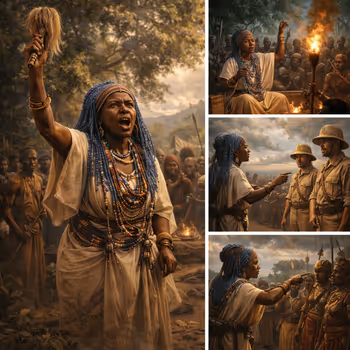
Where Yaa Asantewaa defended a sacred stool, Mekatilili wa Menza defended sacred landscapes and ancestral order along Kenya’s coast.
Her authority did not arise from a throne but from ritual legitimacy.
Through oath-taking ceremonies, invocation of ancestral power, and mass mobilization, she galvanized the Giriama against British colonial interference.
British administrators misread spiritual authority as superstition.
Yet within Giriama cosmology, ritual sanction was political authorization.
Mekatilili did not merely protest taxation or forced labor.
She defended cosmological sovereignty — the right of a people to live within their inherited moral universe.
Like Yaa, her power emerged from guardianship, not ambition. 🌊
Maternal Authority Before Empire 👩🏾👦
Sogolon Kedjou and Dynastic Formation
Long before colonial intrusion, African epic tradition preserved another archetype: the matriarch as architect of destiny.
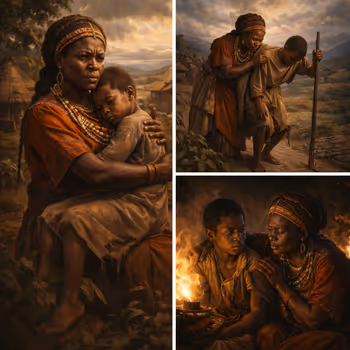
Sogolon, mocked for her appearance and marginalized within the royal court, became the shield and compass of her son Sundiata.
When he was dismissed as a lame child incapable of fulfilling prophecy, she shepherded him through exile, danger, and humiliation.
She did not lead armies. She formed a king.
Even though she did not live to witness Sundiata’s imperial triumph, her role in shaping Mali’s founder reveals something essential: maternal authority in African societies often precedes visible sovereignty.
Before women defended nations, they were already understood as those who made nations possible. 🌾
Patterns of Matriarchal Governance Across Regions 🌍📜
| Figure | Region | Form of Authority | Mode of Resistance | Institutional Basis |
|---|---|---|---|---|
| Yaa Asantewaa | Asante (Ghana) | Queen Mother Governance | Armed defense of sovereignty | Matrilenial constitution |
| Nzinga Mbande | Angola | Monarch-Strategist | Diplomacy + Guerilla War | Dynastic legitimacy |
| Agojie | Dahomey (Benin) | Professional Soldiers | State war vs. France | Military institution |
| Mekatilili wa Menza | Kenyan Coast | Ritual-Political Leader | Mass cultural mobilization | Sacred tradition |
| Sogolon Kedjou | Mali epic tradition | Maternal Nation-Builder | Preservation through exile | Cultural memory |
What Colonial Records Misunderstood About African Women 📚❌
Colonial observers often:
- Mistook matrilineal succession for political weakness.
- Viewed ritual authority as irrational rather than constitutional.
- Recorded female leaders only when they disrupted imperial plans.
- Ignored everyday governance roles already exercised by women.
The archive preserved confrontation but obscured continuity.
What the Deeper Historical Record Reveals 🌿
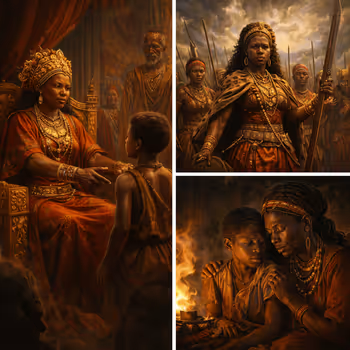
Across regions and centuries, African societies:
- Embedded women within succession systems.
- Entrusted queen mothers with king-making authority.
- Institutionalized female military service.
- Recognized maternal formation as foundational statecraft.
Female leadership was neither imported nor reactive. It was indigenous, structural, and enduring.
Conclusion: Matriarchal Authority as Continuity ✨
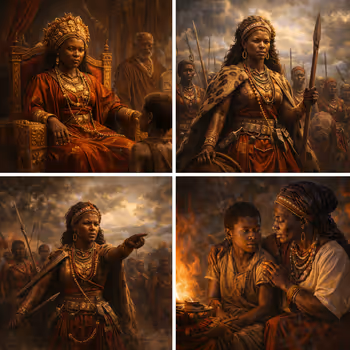
From the forests of Asante to the plains of Angola, from Dahomey’s barracks to the coastal homesteads of the Giriama, African women stood at the hinge of survival.
Empire did not create these leaders.
It exposed them.
Matriarchal authority was not an anomaly triggered by crisis.
It was a covenant between land and lineage, memory and future.
Their defiance was not loud rebellion for its own sake.
It was stewardship.
And in that stewardship lies the deeper truth:
Across sub-Saharan Africa, when sovereignty faltered, women rose first.
0 Comments
Leave a comment