

History often resists simplicity.
Civilizations rarely conform to the tidy narratives we construct around them. They are contradictory, dynamic, and shaped by countless interactions among people with differing beliefs, languages, and aspirations.
Few historical societies illustrate this better than Al-Andalus.
Stretching across large portions of the Iberian Peninsula between the eighth and fifteenth centuries, Al-Andalus occupied a unique position at the crossroads of Africa, Europe, and the broader Islamic world.
It was a place where merchants exchanged goods from distant lands.
Where scholars debated philosophy and medicine.
Where translators labored over manuscripts that would preserve—and transform—the intellectual inheritance of earlier civilizations.
It was also a society marked by political instability, social hierarchies, and periodic conflict.
To acknowledge one reality while ignoring the other is to misunderstand the complexity of the historical experience.
Yet despite these contradictions, Al-Andalus emerged as one of history's most remarkable centres of learning.
Its libraries housed hundreds of thousands of manuscripts.
Its physicians refined medical practice.
Its astronomers mapped the heavens.
Its philosophers wrestled with enduring questions about faith, reason, and human flourishing.
And through networks of translation and transmission, many of these ideas travelled beyond Iberia, contributing to the intellectual awakening that would later reshape Europe.
As someone deeply fascinated by overlooked chapters of world history, I have long been drawn to Al-Andalus precisely because it challenges simplistic assumptions about how civilizations develop.
It reminds us that innovation rarely emerges in isolation.
More often, it arises through encounter.
Through exchange.
Through the willingness to learn from those who perceive the world differently from ourselves.
In revisiting the story of Islamic Spain, my hope is not simply to celebrate a "golden age."
Rather, it is to explore how knowledge moves across cultures, why historical memory matters, and what this extraordinary chapter of human history might still teach us today.
Why Al-Andalus Continues to Fascinate Historians and Writers
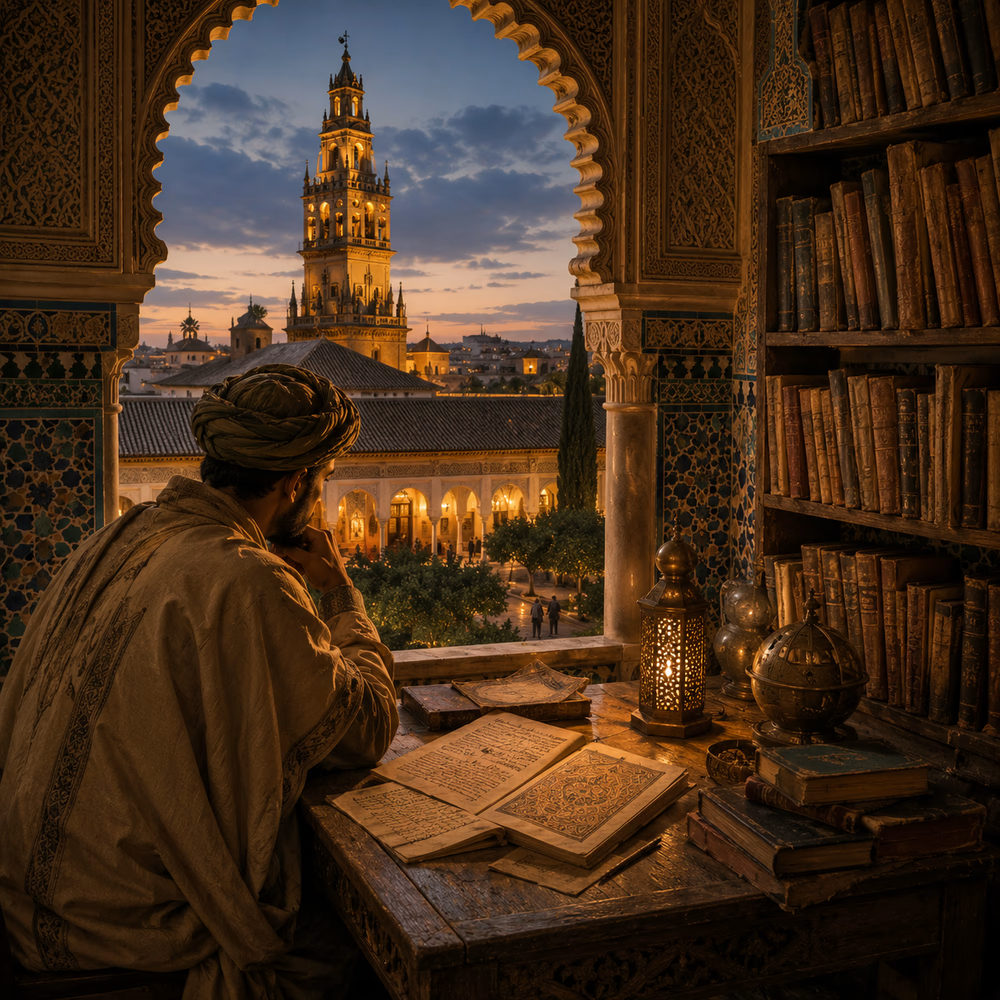
There are certain historical periods that linger in the imagination long after one first encounters them.
For me, Al-Andalus became one of those periods.
Perhaps it was the image of Córdoba's illuminated streets while much of medieval Europe remained comparatively underdeveloped.
Perhaps it was the idea of libraries containing hundreds of thousands of volumes at a time when books themselves were precious commodities.
Or perhaps it was the realization that many concepts often framed as belonging exclusively to one civilization were, in fact, products of centuries of intellectual exchange.
As both a historical fiction writer and an enthusiastic student of history, I find myself continually drawn to stories that complicate inherited narratives.
Stories that resist binaries.
Stories that reveal the unexpected pathways through which ideas travel.
Al-Andalus represents precisely this kind of history.
Its scholars preserved classical knowledge while expanding upon it.
Its physicians built upon earlier traditions while developing new approaches.
Its philosophers engaged critically with the works of Aristotle and Plato while exploring questions that continue to resonate today.
None of this occurred in a vacuum.
Rather, it emerged through dialogue across linguistic, religious, and cultural boundaries.
I suspect this fascination also explains why I am repeatedly drawn to historical subjects that, at first glance, may appear unrelated.
Whether exploring Mekatilili wa Menza's resistance against colonial intrusion along Kenya's coast or revisiting the intellectual achievements of Islamic Spain, I find myself returning to similar questions:
How do communities preserve what they value most?
How do individuals respond when confronted by unfamiliar ideas?
And what responsibilities do we bear as inheritors of histories that remain far more interconnected than we often imagine?
Perhaps the greatest lesson Al-Andalus offers is not merely that remarkable achievements occurred there.
It is that curiosity itself can become an act of bridge-building.
The Rise of Al-Andalus: From Conquest to Intellectual Powerhouse
The story of Al-Andalus begins in 711 CE, when Muslim forces crossed the Strait of Gibraltar from North Africa into the Iberian Peninsula.
Within a relatively short period, much of the region previously governed by the Visigoths came under Muslim rule.
The newly established territories became known as Al-Andalus.
Over the centuries that followed, Al-Andalus underwent significant political transformations.
It evolved from a province connected to the Umayyad Caliphate into the independent Umayyad Emirate of Córdoba, before eventually reaching its zenith as the Caliphate of Córdoba during the tenth century.
Under rulers such as Abd al-Rahman III and Al-Hakam II, Córdoba flourished as a major urban center.
Travelers described bustling markets, public baths, and impressive architectural achievements.
The city's libraries reportedly housed vast collections of manuscripts acquired through extensive networks of trade and scholarship.
Students and scholars journeyed from across the Mediterranean world to study there.
Yet Al-Andalus was never politically static.
Periods of unity alternated with fragmentation.
The collapse of the caliphate in the early eleventh century gave rise to the Taifa kingdoms, independent principalities that frequently competed with one another even as they continued to patronize artistic and intellectual pursuits.
Subsequent centuries witnessed the arrival of the Almoravids and Almohads from North Africa, as well as the gradual territorial expansion of Christian kingdoms during the process often referred to as the Reconquista.
By 1492, with the fall of Granada, Muslim political rule in Iberia had come to an end.
And yet, political decline did not erase intellectual legacy.
The ideas cultivated within Al-Andalus had already travelled far beyond its borders.
Their influence would continue to shape subsequent generations in ways both visible and subtle.
Convivencia: Cultural Exchange, Complexity, and Coexistence
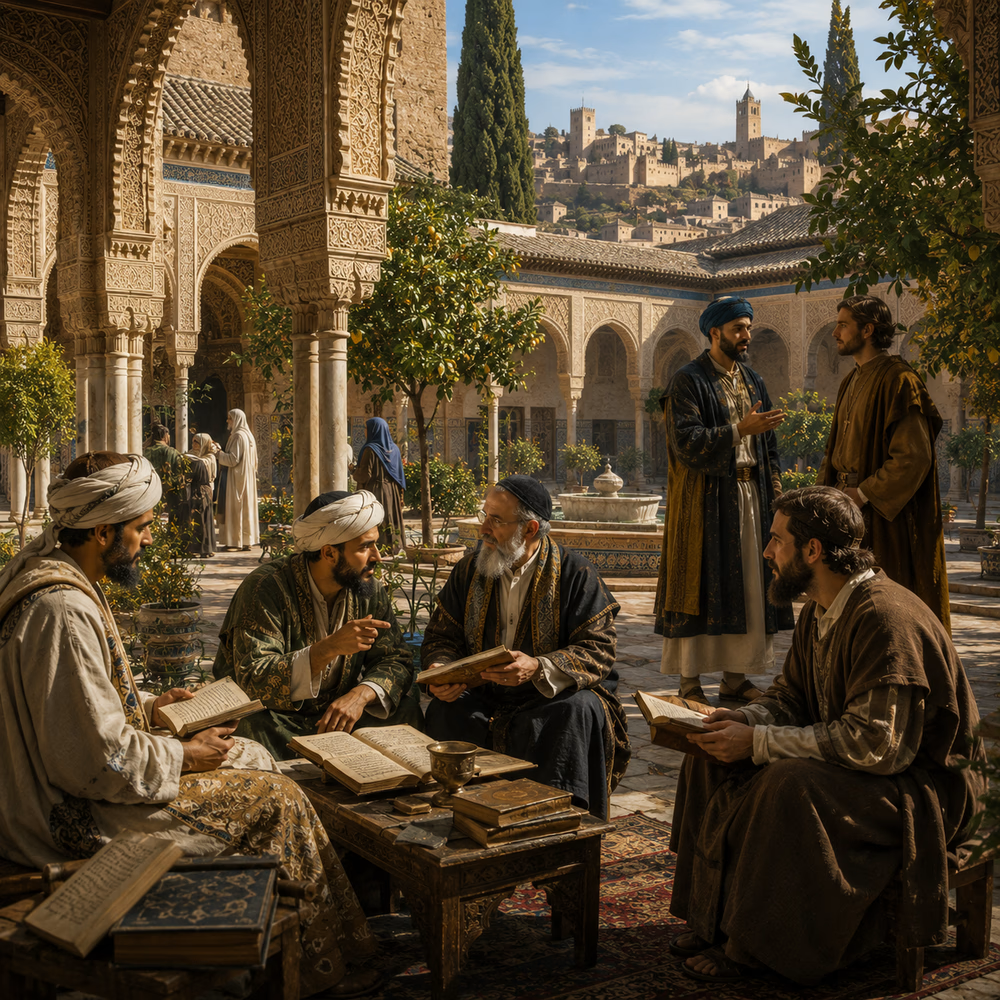
Few concepts associated with Al-Andalus have generated as much discussion as convivencia.
Broadly translated as "living together," the term has often been used to describe periods of coexistence among Muslims, Christians, and Jews within medieval Iberia.
For some scholars and popular writers, convivencia represents an inspiring example of intercultural tolerance and collaboration.
For others, the concept risks romanticizing a far more complicated reality.
The truth likely resides somewhere between these extremes.
Al-Andalus was neither a flawless utopia nor a perpetual battleground.
Relationships among religious communities varied considerably across different regions, social classes, and historical periods.
Moments of cooperation existed alongside episodes of discrimination and conflict.
Legal inequalities shaped daily life.
Political upheavals altered social dynamics.
Yet despite these challenges, intellectual exchange undeniably occurred.
Jewish scholars wrote in Arabic.
Christian translators collaborated with Muslim intellectuals.
Philosophical and scientific ideas moved across linguistic boundaries.
Texts from ancient Greece, preserved and expanded upon within the Islamic world, found new audiences through translation initiatives that would later influence European thought.
Perhaps convivencia matters not because it offers a perfect model for contemporary society.
Rather, it reminds us that human interactions are rarely reducible to simplistic categories.
- People borrow from one another
- Challenge one another
- Learn from one another
- Even amid profound differences
This complexity deserves acknowledgment.
Because the enduring legacy of Al-Andalus lies not in an idealized vision of harmony, but in the recognition that knowledge often flourishes where diverse perspectives meet.
And perhaps that insight remains just as relevant today as it was a millennium ago.
The Golden Age of Science in Islamic Spain
The intellectual flourishing of Al-Andalus did not emerge overnight.
Nor can it be attributed to a single ruler, religion, or institution.
Rather, it arose from a confluence of factors: relative prosperity, extensive trade networks, multilingual scholarship, patronage of learning, and a willingness among many scholars to engage critically with ideas inherited from earlier civilizations.
In this environment, knowledge became more than a private pursuit.
It became a public good.
Libraries expanded.
Educational institutions flourished.
Debates unfolded in courts and scholarly circles.
And in cities such as Córdoba, Seville, Toledo, and Granada, thinkers explored questions whose implications would extend far beyond medieval Iberia.
Córdoba: The City of Books
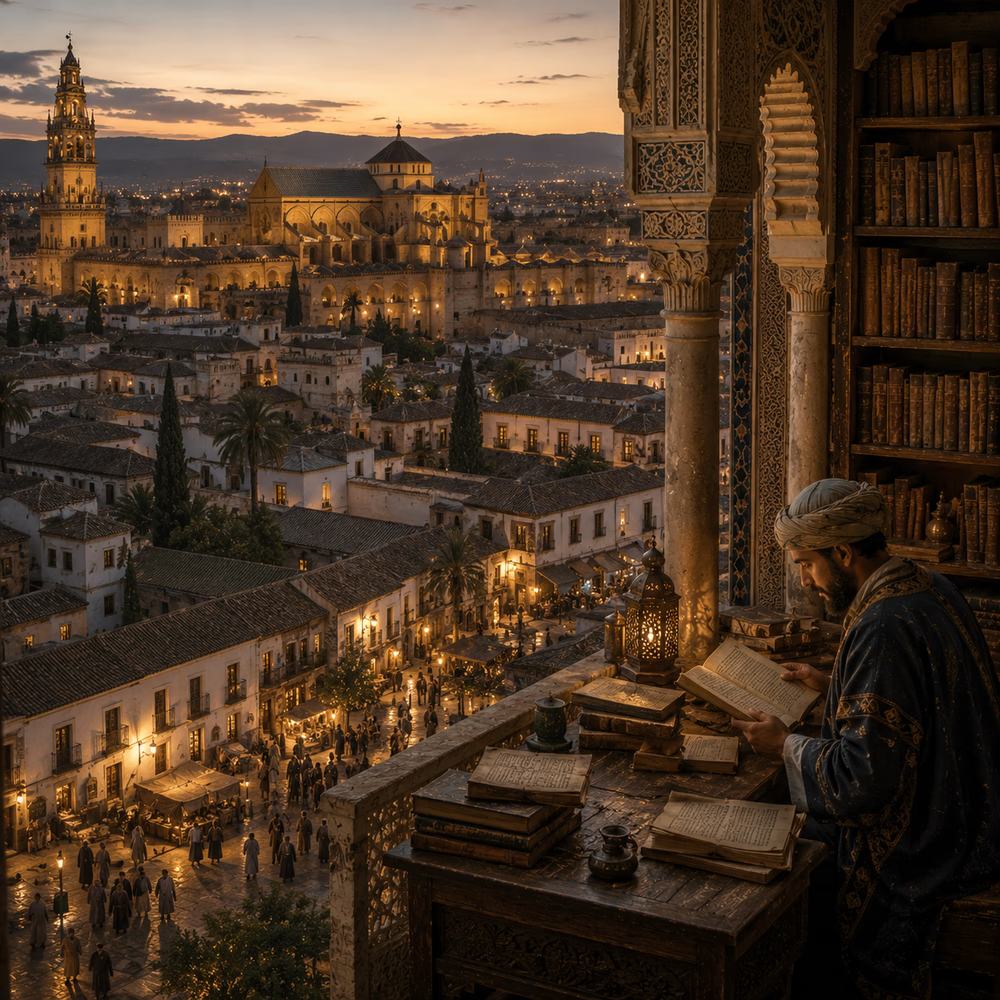
At its height, Córdoba stood among the largest and most sophisticated cities in Europe.
Travelers described paved streets illuminated by oil lamps, bustling markets, public baths, and an urban landscape shaped by remarkable architectural ambition.
Yet perhaps its most extraordinary distinction lay elsewhere.
It was a city devoted to learning.
Under the patronage of rulers such as Al-Hakam II, Córdoba reportedly amassed one of the medieval world's most impressive collections of manuscripts.
Scholars acquired texts from across the Islamic world, translating, preserving, and expanding upon knowledge inherited from Greek, Persian, Indian, and earlier Arab traditions.
Books became symbols of prestige.
Libraries became centres of intellectual life.
Students travelled considerable distances to study within the city's scholarly circles.
While some historical estimates regarding the precise size of Córdoba's libraries remain debated, their broader significance is difficult to overstate.
At a time when books were painstakingly copied by hand, the deliberate cultivation of literary culture reflected a profound commitment to the pursuit of knowledge.
The city became more than a political capital.
It became an intellectual crossroads.
Medicine and Public Health in Al-Andalus
Among Al-Andalus' most enduring contributions were advancements in medicine.
Building upon earlier traditions while introducing important refinements, physicians sought to understand disease through observation, experimentation, and systematic study.
One of the most influential figures associated with this period was Abu al-Qasim al-Zahrawi, known in Latin as Abulcasis.
Often regarded as one of history's pioneering surgeons, Al-Zahrawi authored Al-Tasrif, an encyclopedic medical text that documented surgical procedures, instruments, and clinical observations.
The work would later influence medical education throughout Europe for centuries.
Physicians in Al-Andalus explored topics ranging from pharmacology and ophthalmology to diet and preventative care.
Hospitals within the broader Islamic world increasingly emphasized patient welfare, professional standards, and practical training.
Although medieval medicine remained constrained by the scientific limitations of its era, the commitment to rigorous documentation represented a significant intellectual achievement.
Importantly, these developments remind us that medicine has always been cumulative.
Progress emerges through generations of practitioners building upon the insights of those who came before them.
Astronomy, Mathematics, and Scientific Inquiry
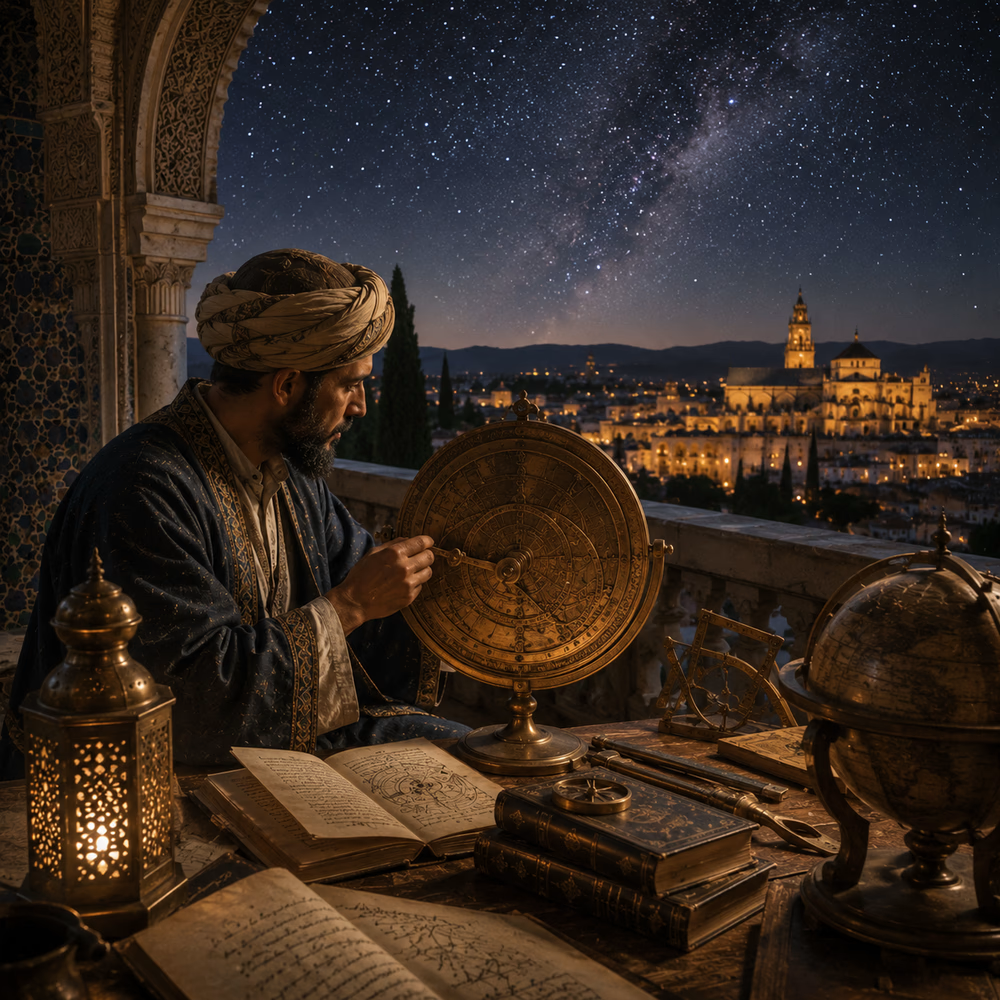
For medieval scholars, the night sky represented both wonder and necessity.
Astronomical observations informed religious practices, agricultural planning, navigation, and calendar systems.
Within Al-Andalus, astronomers refined instruments and calculations that enhanced humanity's understanding of celestial phenomena.
The astrolabe, an instrument used to determine the positions of stars and planets, became increasingly sophisticated through centuries of refinement within the Islamic world.
Its applications extended far beyond astronomy, assisting travelers and navigators alike.
Meanwhile, mathematical knowledge inherited from earlier civilizations continued to evolve.
Scholars worked with concepts originating from Indian numerical systems while advancing algebraic and geometric reasoning developed throughout the Islamic Golden Age.
The transmission of these ideas would eventually influence educational traditions across Europe.
Their legacy persists today.
Every modern engineering calculation, architectural blueprint, and scientific model owes something to centuries of mathematical inquiry conducted by countless individuals across diverse societies.
Al-Andalus formed part of this broader story.
Ibn Rushd and the Tradition of Rational Inquiry
Perhaps no dimension of Al-Andalus better illustrates the complexity of intellectual life than its philosophical traditions.
Scholars grappled with enduring questions concerning faith, reason, ethics, and the nature of knowledge itself.
Among the most celebrated thinkers associated with Islamic Spain was Ibn Rushd, known in the Latin West as Averroes.
A philosopher, jurist, and physician, Ibn Rushd became renowned for his extensive commentaries on Aristotle.
He argued that reason and revelation need not exist in opposition.
Rather, both represented legitimate pathways toward truth when properly understood.
His writings would later influence philosophical debates far beyond Iberia, shaping conversations among Christian and Jewish thinkers throughout medieval Europe.
Other intellectuals, including Moses Maimonides, similarly navigated the intersections between inherited traditions and rational inquiry.
Their efforts remind us that philosophy is rarely an abstract exercise detached from lived experience.
Instead, it reflects humanity's ongoing attempt to make sense of existence, justice, responsibility, and meaning.
These questions remain as relevant today as they were a thousand years ago.
Agricultural Innovation and Environmental Knowledge
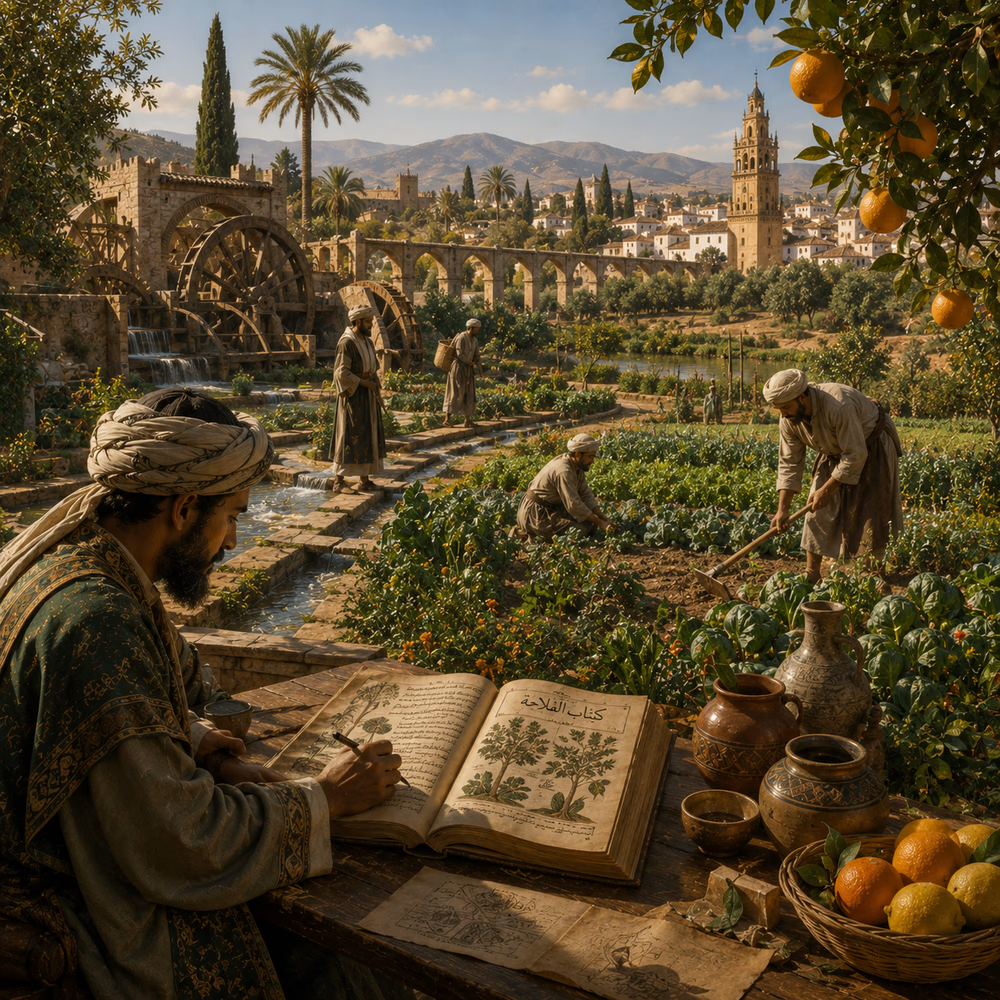
Discussions of scientific achievement often privilege astronomy, medicine, or philosophy.
Yet some of Al-Andalus' most transformative innovations unfolded much closer to the ground.
Agricultural knowledge expanded through experimentation, adaptation, and the exchange of techniques across regions.
New irrigation systems improved water management.
Crop diversification enhanced food security.
Agricultural treatises documented practical insights concerning cultivation, soil conditions, and seasonal cycles.
The introduction and wider cultivation of crops such as citrus fruits, rice, sugarcane, and certain vegetables contributed to significant transformations in local economies and dietary practices.
These developments reflected an important truth:
Innovation is not confined to laboratories or royal courts.
Sometimes it manifests through the patient refinement of everyday practices that sustain communities.
In this sense, agricultural advancement constituted one of Al-Andalus' most quietly revolutionary achievements.
Architecture, Engineering, and Urban Design
The architectural legacy of Al-Andalus continues to captivate visitors centuries after its political decline.
Structures such as the Great Mosque of Córdoba and the Alhambra testify not only to artistic sophistication but also to remarkable engineering ingenuity.
Architects combined aesthetic ambition with practical considerations.
Water management systems supported gardens and urban populations.
Intricate geometric designs reflected mathematical precision.
Courtyards moderated temperature through thoughtful environmental adaptation.
Architecture became a dialogue between functionality and beauty.
It revealed an understanding that built environments shape human experience.
Importantly, these achievements emerged through collaboration among artisans, engineers, craftsmen, and patrons.
Great structures are rarely the products of isolated genius.
They represent collective endeavor.
And through their enduring presence, they continue to invite reflection upon the societies that imagined them into being.
Military Innovations and Strategic Thinking
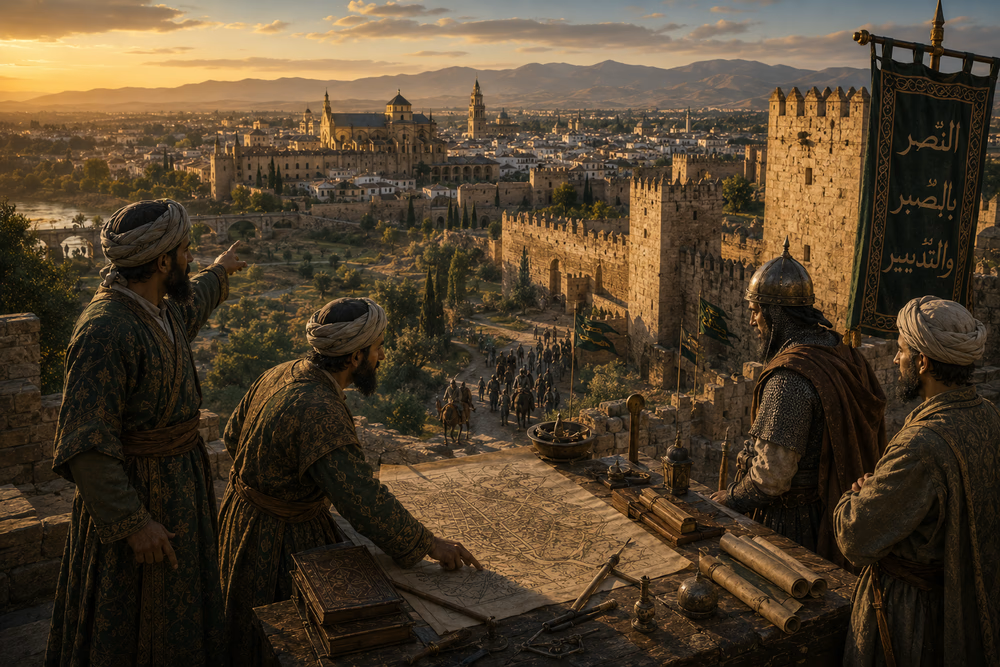
Any honest appraisal of Al-Andalus must acknowledge that its history unfolded within a context of shifting alliances, political rivalries, and periodic warfare.
Military considerations therefore influenced aspects of technological and strategic development.
Fortifications evolved in response to changing threats.
Urban planning incorporated defensive features.
Knowledge concerning logistics, communication, and resource management assumed practical importance.
Yet perhaps the most significant lesson lies elsewhere.
The rise and fragmentation of Al-Andalus underscore the reality that intellectual flourishing does not render societies immune to political instability.
Knowledge alone cannot eliminate conflict.
Nor can military strength guarantee cultural continuity.
Civilizations endure through a delicate balance of resilience, adaptability, and institutional stewardship.
The story of Al-Andalus reminds us that remarkable achievements can coexist with profound vulnerabilities.
Recognizing this complexity deepens our appreciation of history.
It encourages humility.
And it cautions against simplistic narratives of inevitable progress or decline.
Collectively, these contributions reveal something essential about Al-Andalus.
Its significance extends beyond isolated discoveries or celebrated individuals.
It lies in the cultivation of an environment where curiosity was encouraged, knowledge circulated across boundaries, and scholars sought not merely to preserve inherited wisdom but to expand it.
The resulting legacy would travel far beyond medieval Iberia.
And in doing so, it would help shape the intellectual foundations upon which later generations continued to build.
The Legacy of Knowledge: How Al-Andalus Continues to Shape Our World
The achievements of Al-Andalus did not remain confined to the Iberian Peninsula.
Ideas have a remarkable tendency to travel.
Sometimes they cross borders through conquest or trade.
At other times, they journey quietly through books, conversations, mentorship, and the patient labor of translators.
The intellectual legacy of Islamic Spain owes much to this movement of knowledge across cultures and generations.
Its story reminds us that civilizations do not flourish in isolation.
Rather, they inherit, adapt, refine, and transmit wisdom in ways that continually reshape the human experience.
The Toledo School of Translators
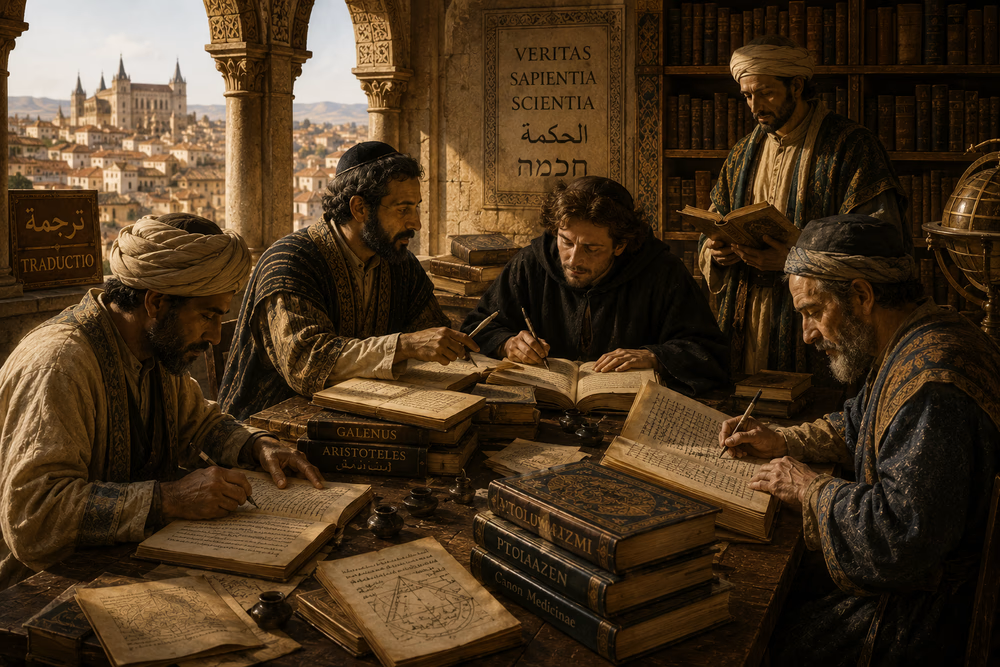
Following the Christian reconquest of Toledo in 1085, the city emerged as one of medieval Europe's most important centres of translation.
Scholars from diverse linguistic and religious backgrounds collaborated to translate Arabic texts into Latin and, in some cases, Castilian.
These efforts introduced European audiences to an extraordinary body of knowledge encompassing philosophy, medicine, mathematics, astronomy, and natural science.
Many of these texts had themselves passed through multiple intellectual traditions.
Ancient Greek works preserved and expanded upon by Muslim scholars now found new readerships.
Jewish intellectuals frequently played vital intermediary roles in these exchanges.
The process was neither simple nor linear.
Translation requires interpretation.
Interpretation demands judgment.
And yet, through these collaborative efforts, ideas continued their journey.
The Toledo translators remind us that preserving knowledge is not a passive act.
It is creative labor.
An affirmation that understanding across difference remains possible.
Al-Andalus and the Road to the Renaissance
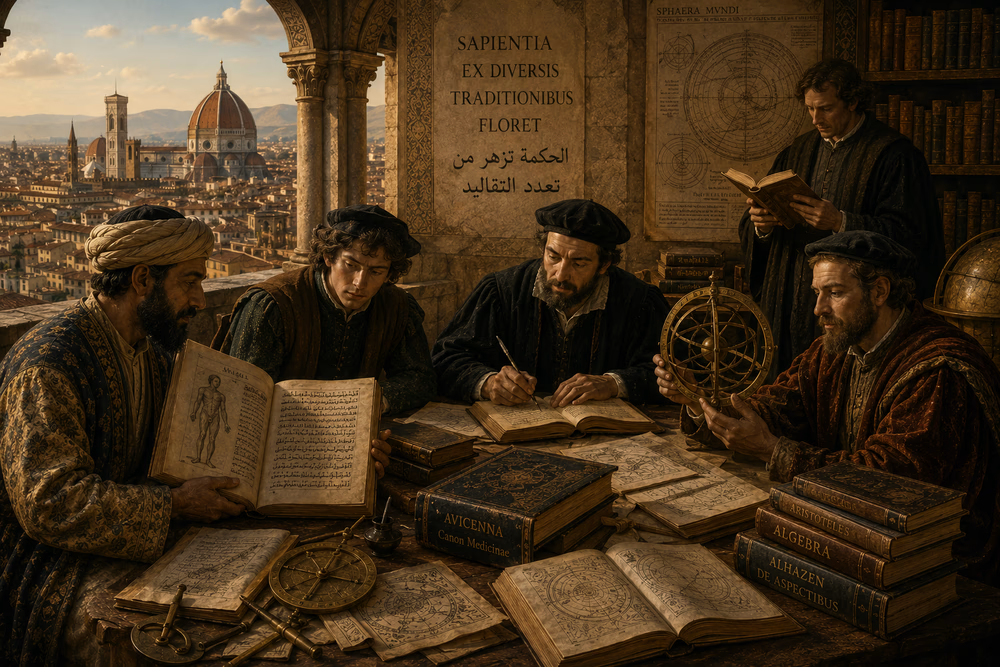
Historians continue to debate the precise extent to which Al-Andalus influenced the European Renaissance.
What remains clear, however, is that medieval Europe's intellectual landscape was profoundly enriched through contact with the broader Islamic world.
Translations of philosophical works stimulated new debates concerning faith and reason.
Medical treatises informed educational curricula.
Mathematical concepts enhanced scientific inquiry.
Astronomical observations expanded humanity's understanding of the cosmos.
Importantly, these developments should not be understood as a simple transfer of knowledge from one civilization to another.
The Renaissance emerged through numerous historical processes involving multiple regions and traditions.
Yet Al-Andalus undeniably formed part of this wider story.
- Its scholars preserved
- Its thinkers innovated
- Its translators transmitted
And through these interconnected efforts, knowledge continued to evolve.
Perhaps the Renaissance itself serves as a reminder that intellectual progress often depends upon humility:
The willingness to acknowledge that wisdom rarely belongs exclusively to any single people.
Decline, Erasure, and Historical Memory
The fall of Granada in 1492 marked the end of Muslim political authority in Iberia.
Subsequent decades witnessed profound transformations.
Communities faced increasing pressures to convert.
Religious diversity diminished.
Many manuscripts disappeared through neglect, censorship, or destruction.
Historical memory became contested terrain.
Yet decline did not erase contribution.
Ideas continued to circulate long after the political structures that nurtured them had vanished.
Architectural achievements endured.
Philosophical debates persisted.
Scientific knowledge remained embedded within educational traditions.
This tension between remembrance and forgetting invites reflection.
Which histories do societies preserve?
Which do they marginalize?
And what responsibilities do we bear in revisiting narratives that challenge inherited assumptions?
Historical recovery cannot undo past losses.
It can, however, encourage more nuanced understandings of the human story.
Why the Legacy of Al-Andalus Still Matters Today
As I researched Al-Andalus, I found myself returning repeatedly to a recurring theme:
Some of humanity's most transformative moments occur at the intersection of cultures.
When translators bridge linguistic divides.
When scholars build upon the discoveries of those who came before them.
When curiosity triumphs over fear.
These encounters are rarely uncomplicated.
- They involve negotiation
- Misunderstanding
- Adaptation
- Yet they also generate possibilities
Perhaps this is one reason histories such as Al-Andalus continue to resonate with me as both a student of history and a novelist.
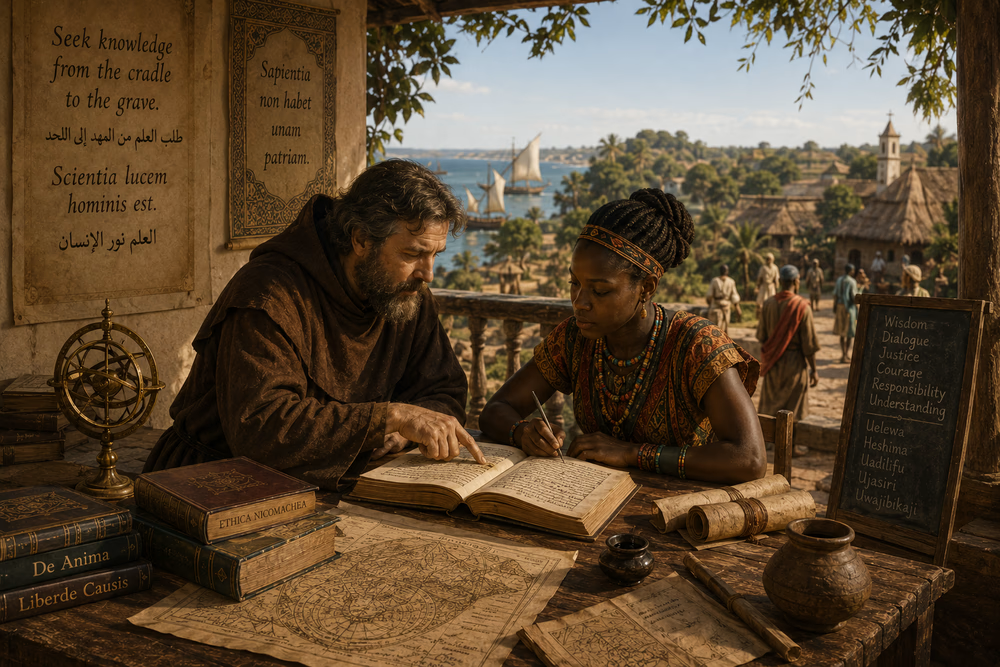
In Echoes of Valor, one of the characters who profoundly shapes Mnyazi's intellectual development is Friar Mark, a fictional Scottish missionary and classical scholar stationed in Rabai.
Although separated from Al-Andalus by geography and centuries, Friar Mark embodies a similar idea:
That wisdom can emerge through unexpected encounters.
Recognizing Mnyazi's potential, he teaches her to read and write.
He then introduces her to philosophical traditions that challenge and expand her understanding of leadership, justice, and responsibility.
Through their conversations, Mnyazi grapples with questions surrounding ethical action, communication, civil disobedience, systemic injustice, and the difficult choices demanded by resistance.
These moments are not intended to diminish indigenous knowledge traditions.
Rather, they acknowledge a truth evident throughout history:
Human beings have long learned from one another across boundaries of culture, language, and belief.
Whether examining the scholarly traditions of Al-Andalus or imagining the intellectual formation of a young Mnyazi, I remain fascinated by the same enduring question:
What becomes possible when we approach unfamiliar ideas with humility and curiosity?
Knowledge is among humanity's greatest shared inheritances.
And perhaps our collective future depends, in part, upon our willingness to continue learning from one another.
Final Reflections: Reclaiming the Story of Islamic Spain
Revisiting Al-Andalus is not an exercise in nostalgia.
Nor is it an attempt to construct idealized visions of the past.
Rather, it offers an opportunity to embrace complexity.
To recognize that civilizations are rarely defined solely by conquest or conflict.
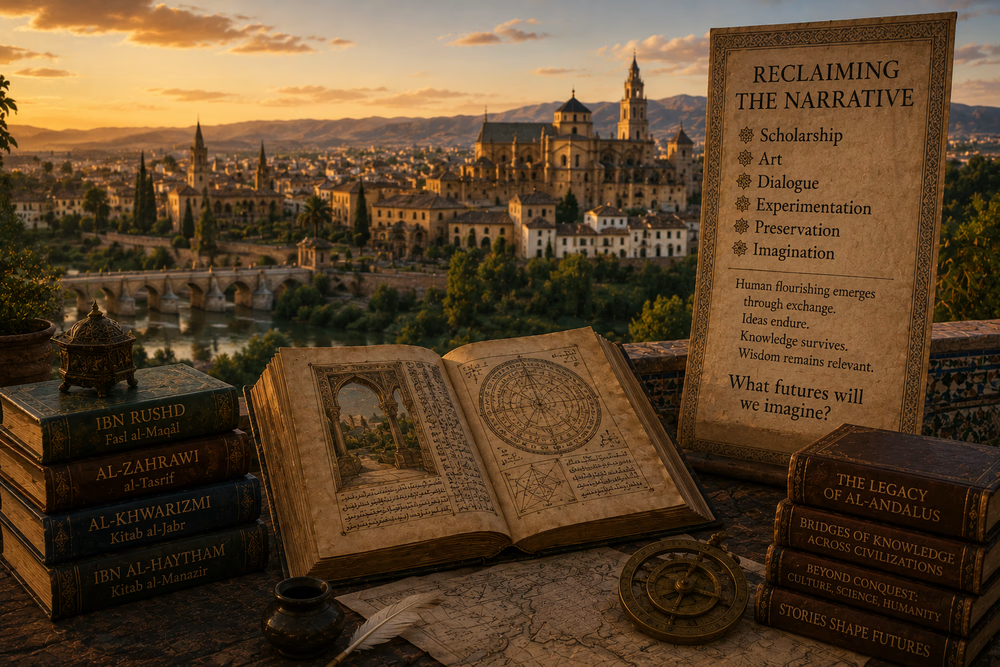
They are also shaped by:
- Scholarship
- Art
- Dialogue
- Experimentation
- Acts of preservation
- Acts of imagination
The story of Islamic Spain reminds us that human flourishing often emerges through exchange rather than isolation.
Its legacy challenges simplistic narratives that divide civilizations into rigid categories of "East" and "West."
And perhaps most importantly, it invites us to ask better questions of history itself.
Not merely:
Who won?
But also:
What ideas endured?
What knowledge survived?
What wisdom remains relevant today?
Because the stories we choose to remember inevitably shape the futures we imagine.
0 Comments
Leave a comment